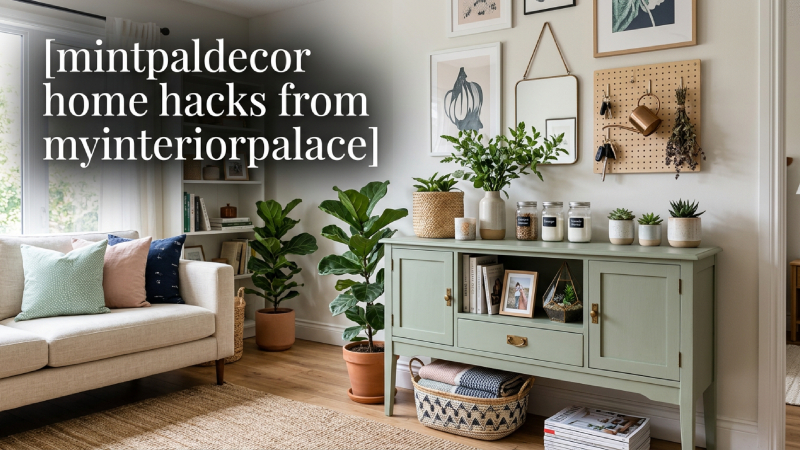
Scroll far enough through Pinterest boards or Instagram’s tag pages and you will hit the phrase “mintpaldecor home hacks from myinteriorpalace.” It shows up attached to shelf-styling photos, storage roundups, and budget-makeover clips that have been saved thousands of times. The name reads like a brand — maybe a studio, maybe a product line. The reality is more ordinary, and more useful: it is a label for a loose web of decorating advice sites that publish practical, low-cost guidance for people fixing up their homes. And once you understand that, you can stop worrying about the name and start judging the ideas on their own.
What the Name Actually Is
A quick look at the sites carrying these names — such as MintPalDecor and MyInteriorPalace — shows they are content hubs, not companies you can call or shop with. They publish guides on interior design, renovation, color, storage, and seasonal updates. There is no verified founder, no product catalog, and no trackable history behind the phrase, and some of the pages that rank for it are little more than repackaged general decorating content.
That matters for one reason: it tells you what kind of source you are dealing with. Treat these hacks the way you would advice from any anonymous blog — check the reasoning, test it in one small corner of your house, and keep what survives. The point of this article is to sort that advice by what holds up in a real room, with a real budget, and no designer on call.
Read the Room Before You Touch Anything
The most expensive mistake in decorating is buying things before you understand the space they’re entering. Most advice assumes your room is a blank canvas. Yours isn’t — it has a light source, awkward corners, and a set of daily habits that no photo will show you.
Start with light. The single most common problem in ordinary homes is under-lighting: one overhead fixture throwing shadows that flatten every surface in the room. Before you spend a dollar on decor, stand in the room at night and ask whether you could read a book comfortably in each corner. The answer for most people is no, and that is the real issue — not the lack of a “statement piece.”
Next, take a photo. This sounds too simple to work, but your eyes adjust to your own space within days, and they stop noticing what’s off. A phone photo taken at eye level, from the doorway, will show you clutter you’ve stopped seeing, furniture that’s the wrong size, and corners that are dead weight. It is the fastest honest feedback loop in decorating, and it costs nothing.
Finally, check scale against function. A room used by two people at a time does not need eight chairs. A small apartment does not need smaller furniture — undersized sofas and skinny consoles actually fragment a space and make it feel emptier. Furniture should anchor a room, not tiptoe around it. Match the pieces to the square footage and to what the room is asked to do at 7 a.m. versus 9 p.m.
The Hacks That Work With One Trip to the Store
Once you’ve read the room, a handful of inexpensive changes deliver most of the visual payoff. These are the hacks that keep showing up under the mintpaldecor label, and they keep showing up because they work.
Fix the light temperature before you fix anything else. Standard ceiling bulbs in many homes run cool and clinical. Swap to bulbs rated around 2700–3000K (warm white) for living rooms and bedrooms, and the same room reads instantly softer and more deliberate — no furniture moved. In kitchens and bathrooms, a brighter neutral works better, so choose the temperature by room purpose, not by habit.
Add a second light source. A floor lamp paired with a table lamp changes a room more than most decor purchases. Aim some light at the walls rather than straight down; light that grazes a wall makes the ceiling feel taller and the room feel wider. Two lamps from a discount store, under $50 combined, outperform a $200 vase.
Swap the hardware. Drawer pulls and cabinet knobs are the jewelry of a room. Replacing dated brass or cheap plastic pulls with matte black, brushed nickel, or unlacquered brass costs a few dollars a piece, takes a screwdriver, and reframes the whole piece of furniture.
Hang mirrors across from windows. A mirror positioned to catch daylight bounces it through the room and visually doubles the light. It is the oldest optical trick in decorating, and it’s free if you already own the mirror.
Paint one wall, not the room. A single accent wall in a deeper tone gives the space a focal point and a sense of depth without committing you to repainting everything when the trend fades.mintpaldecor home hacks from myinteriorpalace?
Renter-Friendly Hacks That Leave No Trace
A large share of the advice under names like myinteriorpalace is aimed at renters, and that’s where the genuinely useful hacks live — because rental constraints force creativity. You can’t paint, you can’t drill into plaster you’ll have to fix later, and everything you buy has to move with you. The workaround toolkit is real and well-established:
- Adhesive strips and hooks (the command-hook family) mount art, curtains, and lightweight shelves without screw holes and remove cleanly. Read the weight limits — that’s where people go wrong.
- Tension rods hang curtains and closet organizers inside doorways and window frames without touching the wall. They work up to a certain width; beyond that, they sag.
- Removable wallpaper has improved markedly in recent years. Quality brands install and peel off without damaging paint, which makes a rented kitchen or bedroom feel owned for as long as you live there.
- Museum putty — the same reusable adhesive used to keep valuables on shelves — stops small decor objects from sliding or toppling, which is also the renters’ version of earthquake-proofing.
- Area rugs do the zoning work that walls can’t. In an open-plan rental, one rug under the sofa and another under the dining table define two “rooms” in a single space and cover flooring you don’t get to choose.
- Hang curtains high. Mounting the rod closer to the ceiling than to the window frame draws the eye upward and makes the wall look taller. This works in any home and costs only the rod’s mounting height.
Storage Hacks for the Spots Everyone Forgets
Storage advice under this label tends to repeat the same three moves: go vertical, go underneath, and make furniture earn its keep. They’re worth repeating because they’re the places people genuinely overlook.
The wall above a doorway is wasted space in most homes; a slim shelf or cabinet there holds infrequently used items without stealing floor square footage. Under-bed storage works best when the boxes have wheels — otherwise the “out of sight” part eventually becomes “out of reach, forever.” The back of a door will accept hooks or a slim rack for bags, scarves, and cleaning supplies, and it costs nothing in floor space.
Multi-function furniture is the strongest hack in the category: a storage ottoman that hides blankets at the foot of a bed, an extendable table that seats four people once a week and two the rest of the time, a bed frame with drawers built in. The rule of thumb is simple — in a small home, every piece should do at least two jobs. And when you’re styling open shelves, group objects in odd numbers (three, five) and vary the heights. It reads as intentional; even numbers read as either symmetrical or cluttered.mintpaldecor home hacks from myinteriorpalace?
Where It’s Worth Spending Real Money
Not every hack is about spending less. The advice worth keeping also tells you where to spend more, because some purchases pay for themselves in longevity.
- Secondhand solid wood over new particleboard. A solid dresser from the 1970s will outlast three flat-pack replacements, cost less up front if you buy used, and can be refinished when it finally wears.
- One quality light fixture — the kind you notice when you walk into the room. This is the single item where design quality is visible every single day.
- A good rug in the room where you spend the most time. It defines the space, absorbs sound, and covers the floor you can’t change.
- Safety hardware. Tall bookshelves, dressers, and TV stands should be anchored to the wall regardless of budget. This isn’t decor advice; it’s the one item on this list that prevents a trip to the emergency room.
Hack, Principle, and Realistic Cost
The table below is a rough map of the ideas above — what to do, why it works, and what it typically runs (prices vary widely by region and store, so treat these as ballparks, not quotes).
| Hack | Principle it works on | Typical cost |
| Swap bulbs to 2700–3000K | Warm light changes color perception of everything in the room | $10–30 |
| Add floor + table lamp combo | Layered light removes flat shadows | $35–100 |
| Replace cabinet hardware | New finish reframes an old piece | $25–90 |
| Mirror across from a window | Bounces daylight around the space | $0–80 |
| Tension-rod curtains hung high | Raises the visual ceiling line | $15–50 |
| Wheels on under-bed boxes | Kills the friction that makes storage fail | $10–25 |
| One solid-wood secondhand piece | Durability beats replacement cost over years | $75–300 |
The pattern across every row: the changes that feel most dramatic when you walk in — light, hardware, height, rug — are the ones that cost the least. The expensive items earn their keep through years of daily use, not through first impressions.
The Room Is the Argument
Strip away the brand names and the search tags, and the core of the mintpaldecor home hacks from myinteriorpalace that survives is small and consistent: fix the light, correct the scale, use what you already own before buying anything new, and spend your real money only where daily use will pay it back. None of that requires a design degree, a big budget, or permission from a landlord.mintpaldecor home hacks from myinteriorpalace?
The honest next step is deliberately modest. Choose one room. Take the photo test tonight. Tomorrow, change the bulbs and move one lamp into a corner that’s currently dark. Rearrange something you already own before you buy anything. Give it a week — that’s how long it takes to see whether a change is actually working — then decide on the single next purchase. One small, reasoned room beats a house full of copied trends, every time.
Quick Answers to the Questions That Hang Over the Hacks
Will these hacks damage the walls in a rented place? The adhesive-strip, tension-rod, and removable-wallpaper methods are designed to come off without marks, as long as you respect weight limits and remove them slowly. Heavy items — bookshelves, tall dressers — should never ride on adhesive alone; anchor them properly. That isn’t a landlord rule, it’s a safety rule.
Why do my bulbs look different even though they’re all “warm white”? Because brightness (lumens) and color temperature (Kelvin) are separate numbers, and cheap bulbs vary more. Buy the same color temperature from the same brand for matching light across a room, and check the lumens rather than the wattage equivalent.
Which of these hacks stop working in a genuinely tiny space? The scale rules shift: in a very small room, one well-proportioned piece beats several small ones, and every object has to justify its floor space. Lighting and mirror tricks still work — in fact they matter more — but multi-function furniture stops being optional and becomes the whole strategy.
Click for more details