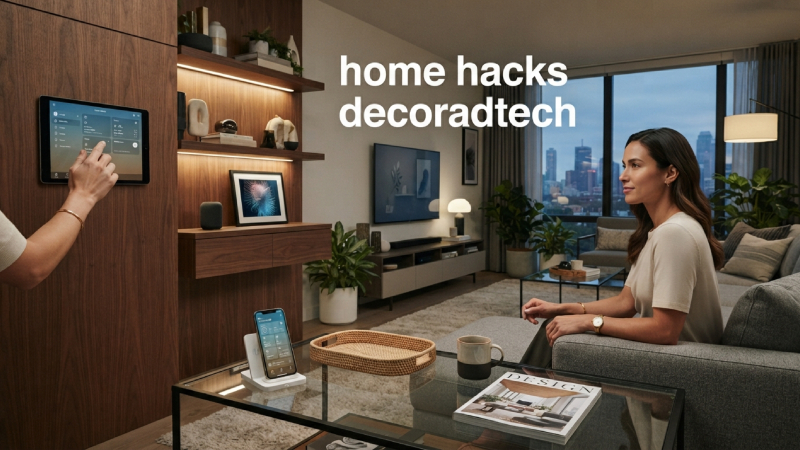
You can make a home feel much more comfortable and inviting without taking on a major renovation.Sometimes the biggest improvement comes from fixing small annoyances: a dark corner, an awkward storage area, messy cables, or a routine that requires too many manual steps. Home hacks decoradtech brings these ideas together by connecting practical home improvements with decoration and useful technology.
The term is used online to describe a blend of home organization, interior improvements, and smart-home solutions. It is better viewed as a flexible approach than a formal design system. The goal is simple: make a space easier to live in while keeping it visually comfortable.home hacks decoradtech?
The Real Idea Behind Decoradtech
The useful part of this concept is not buying more gadgets. It is deciding what your home needs and then choosing an appropriate solution.
For instance, a messy entryway may need a small organizer rather than a smart device. A dark hallway might benefit from motion-activated lighting. A television area may simply need better cable organization.
Think of the approach as three connected layers:
| Layer | What it improves | Practical examples |
| Space | How the room functions | Storage, furniture placement, decluttering |
| Appearance | How the room feels visually | Lighting, textiles, finishes, wall accents |
| Technology | How everyday tasks are handled | Smart bulbs, plugs, sensors, thermostats |
The strongest projects usually begin with the first layer. Once the space works properly, decorative and technological additions become easier to judge.
Fix Friction Before Adding Technology
Before purchasing anything, spend a few minutes noticing what repeatedly bothers you.
Maybe you charge your phone in an inconvenient location. Perhaps the kitchen counter becomes crowded every evening. You may have lights that are difficult to reach from the sofa. These small frustrations are useful clues.
Write down three problems and rank them by how often they occur. Then solve the easiest one first.
This prevents a common mistake: purchasing an impressive-looking device that does not actually improve daily life.
Home Hacks Worth Trying
1. Create a Dedicated Charging Zone
Instead of allowing chargers to spread across tables and countertops, choose one convenient location for everyday devices. A small tray or organizer can keep cables together.
If you later add a smart charging accessory, it has a defined place rather than becoming another source of clutter.
2. Give Dark Areas Their Own Lighting
A single ceiling fixture does not always provide useful illumination everywhere. Add focused lighting where activities actually happen.
A desk, reading nook, kitchen counter, or closet can be more functional when it has dedicated lighting.Smart bulbs can provide scheduling or remote control, but a conventional LED may be all you need.
3. Use Vertical Space More Intentionally
Walls often provide unused storage potential. Narrow shelves, hooks, and wall-mounted organizers can move everyday items away from crowded surfaces.
This works particularly well in smaller rooms because it adds organization without requiring another large piece of furniture.
4. Make Cables Less Noticeable
Technology can quickly make a carefully decorated room look unfinished. Group cables according to destination, shorten unnecessary runs, and use appropriate cable-management accessories.
For permanently installed electrical work, follow local requirements and use qualified help when necessary. Decorative cable hiding should never interfere with ventilation or electrical safety.
5. Automate One Repetitive Task
Choose something you do almost every day. A suitable smart plug, light, or sensor may remove a small repetitive step.
For example, a compatible lamp could follow a schedule instead of being switched manually each evening. Smart-home guidance commonly emphasizes automation and remote control as practical uses rather than technology for its own sake.
6. Make Small Furniture Changes First
Before replacing furniture, experiment with placement. Moving a chair, changing the position of a side table, or creating a clearer walkway can alter how a room functions.
Take a photo before making the change and another afterward. Comparing the two can reveal improvements that are difficult to notice while moving things around.
Match the Solution to the Room
Different spaces need different priorities. A useful hack in a bedroom may be unnecessary in a kitchen.
| Room | Common problem | Practical starting point | Optional tech |
| Living room | Visual clutter | Cable organization and furniture layout | Smart lighting |
| Kitchen | Crowded worktops | Better storage zones | Smart plugs for compatible devices |
| Bedroom | Poor nighttime routine | Bedside organization and layered lighting | Scheduled lights |
| Hallway | Dark or inconvenient | Better illumination and hooks | Motion sensor |
| Home office | Cable and desk clutter | Desk organization | Smart power control |
| Bathroom | Limited storage | Vertical organizers | Suitable humidity-related automation |
This approach keeps technology proportional to the actual need.
Decor Should Hide Problems, Not Create Them
A smart device can be useful while still looking out of place. Before buying one, consider where it will live, whether its size suits the room, and whether its cables or accessories will become visible.
The same principle applies to decorative upgrades. A beautiful storage basket is less useful if it is too small for the items it needs to hold. A stylish lamp is not a good solution if it leaves the work area poorly lit.
Function should set the requirement; appearance should help the solution fit.
Think About Energy and Smart Controls
Some home technologies can also help people manage energy use. ENERGY STAR identifies smart thermostats as devices that can provide scheduling, remote control, and other automated features, depending on the model. Compatibility with the home’s heating and cooling system is important before installation.home hacks decoradtech?
Efficient lighting can also be a straightforward starting point. The U.S. Department of Energy notes that LED lighting is highly efficient and can be combined with controls such as dimming and occupancy sensors.
These examples show why a useful upgrade should be judged by what it does, not simply by how advanced it sounds.
A Simple Upgrade Order
Not sure where to start? Try following this order:
- Remove things you no longer need.
- Rearrange furniture around how the room is actually used.
- Improve problem areas such as lighting and storage.
- Organize visible technology and cables.
- Add one smart feature that solves a specific inconvenience.
- Live with the change before buying another upgrade.
This gradual method makes it easier to tell which improvements are genuinely valuable.
What to Avoid
Not every popular home hack deserves a place in your home. Be cautious about projects that require unnecessary spending, complicated installation, or unsupported claims about savings.
Also check connected devices for privacy and security features. CISA provides guidance on Internet of Things security, making device security an important consideration alongside appearance and convenience.
Most importantly, avoid turning every ordinary household task into an automated process. A smart feature is useful when it removes friction. If it creates another app, account, notification, or maintenance task, the upgrade may not be worth it.
Final Takeaway
Home hacks decoradtech works best as a practical mindset rather than a shopping list. Start by identifying what makes your home inconvenient, unattractive, or difficult to organize. Then make the smallest sensible improvement.
Better storage, thoughtful lighting, cleaner technology placement, and selective automation can work together without making a home feel overloaded with gadgets. The objective is not to make every part of a house “smart.” It is to create a space that looks intentional, works efficiently, and feels easier to use every day. Click for more details